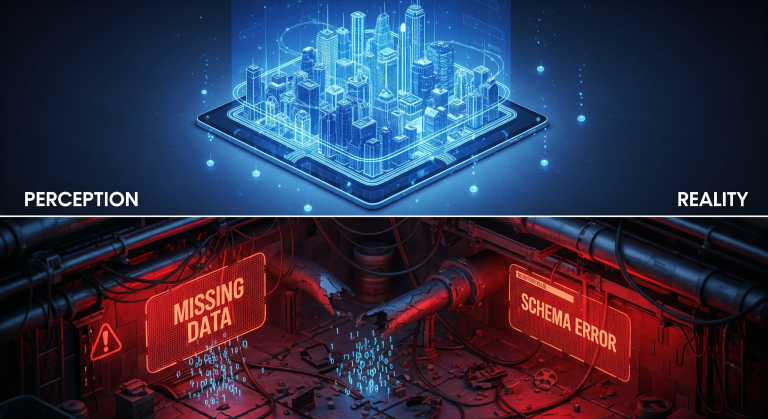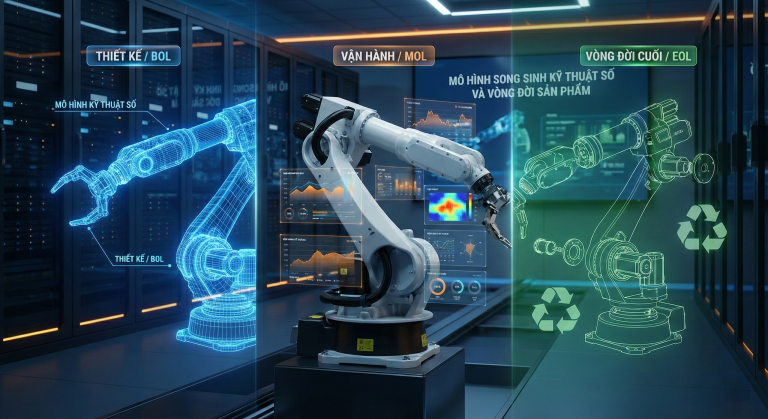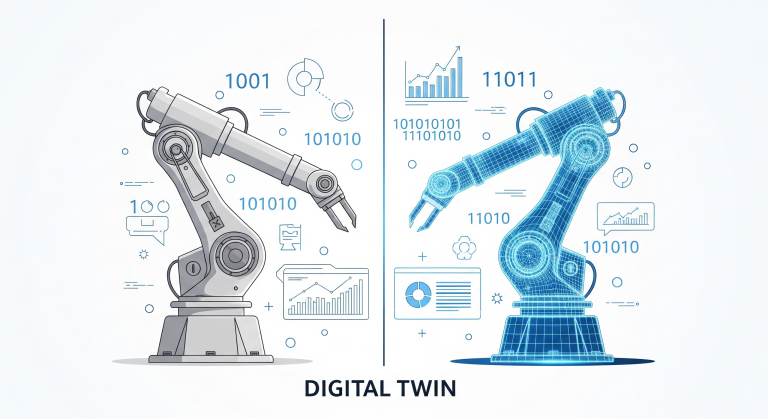
Việc xây dựng một bản thử nghiệm (POC) cho Digital Twin (Bản sao kỹ thuật số) có thể dễ dàng, nhưng khi bạn muốn mở rộng quy mô lên cấp độ toàn doanh nghiệp, kiến trúc dữ liệu của bạn rất dễ bị phá vỡ. Những rào cản lớn nhất không nằm ở giới hạn phần mềm mà nằm ở chính các đường ống dữ liệu (data pipelines).
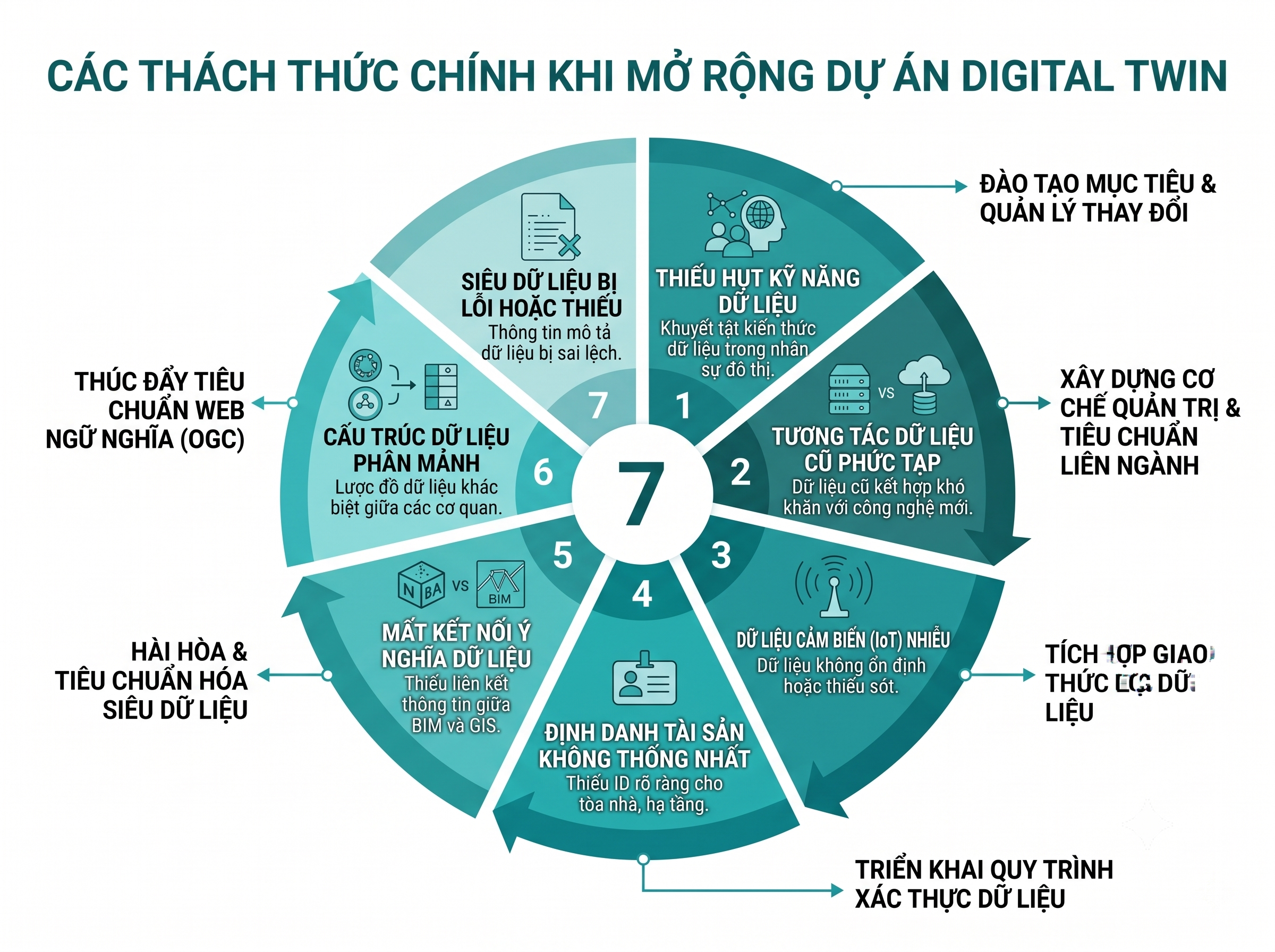
Khi chuyển từ giai đoạn thử nghiệm sang vận hành thực tế, các doanh nghiệp thường gặp phải 3 rào cản chí mạng:
- Tích hợp dữ liệu lỗi thời: Ép buộc các định dạng công nghệ vận hành (OT) cũ kỹ kết hợp với các API đám mây hiện đại.
- Xung đột ngữ nghĩa: Sở hữu dữ liệu BIM không có thuộc tính và dữ liệu GIS thiếu tính liên kết ngữ nghĩa.
- Nhầm lẫn định danh tài sản: Không có hệ thống ID rõ ràng để lập bản đồ các tòa nhà, đường ống và cơ sở hạ tầng trên các nền tảng khác nhau.
Để giải quyết những vấn đề này, bạn không thể chỉ dựa vào việc tăng cường sức mạnh điện toán. Dưới đây là chiến lược chuẩn hóa và tối ưu hóa Digital Twin cho doanh nghiệp của bạn.
1. Giải Quyết Nút Thắt Tích Hợp API Bằng Unified Namespace (UNS)
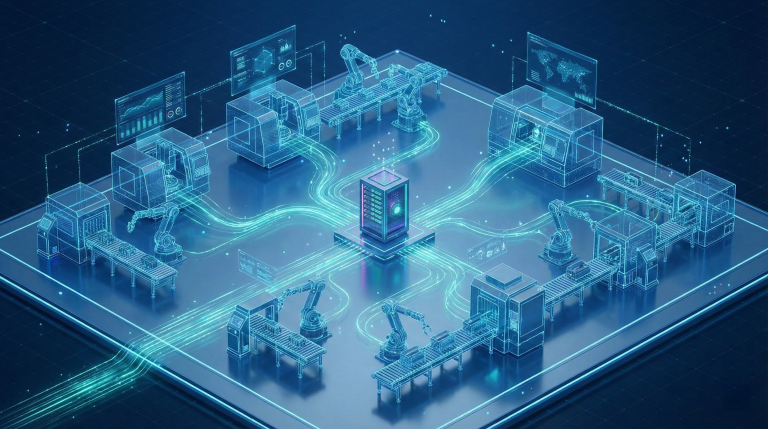
Việc kết nối trực tiếp (point-to-point) giữa hệ thống cũ (như SCADA, ERP) với hệ thống mô phỏng sẽ tạo ra một mớ bòng bong các kết nối phức tạp và dễ lỗi. Để khắc phục, doanh nghiệp cần áp dụng Unified Namespace (UNS) kết hợp với giao thức MQTT và Sparkplug B.
- UNS là gì? Đây là một trung tâm dữ liệu hoạt động theo mô hình xuất bản – đăng ký (publish-subscribe). Nó đóng vai trò là nguồn sự thật duy nhất cho toàn bộ trạng thái hoạt động của doanh nghiệp.
- Lợi ích: Các thiết bị cảm biến phần cứng chỉ cần gửi dữ liệu đến một trung tâm duy nhất, và các ứng dụng phân tích sẽ tự động lấy dữ liệu từ đó mà không cần kết nối trực tiếp. Điều này giúp hệ thống mở rộng dễ dàng và giảm thiểu độ trễ mạng.
2. Hợp Nhất Dữ Liệu BIM và GIS Thông Qua Knowledge Graph
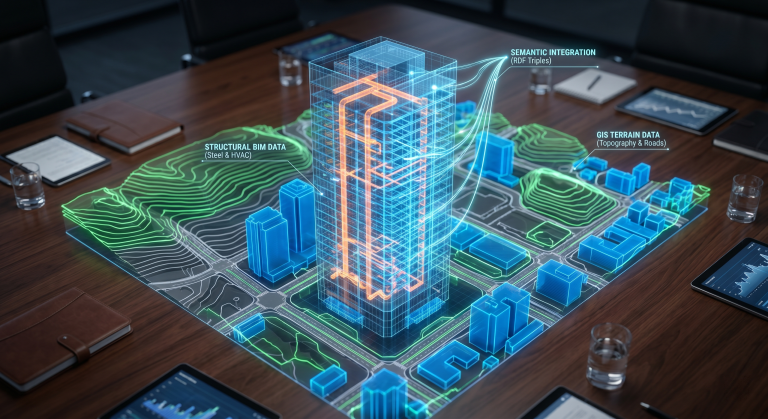
BIM (Mô hình thông tin xây dựng) tập trung vào chi tiết vi mô kiến trúc, trong khi GIS (Hệ thống thông tin địa lý) tập trung vào bối cảnh vĩ mô. Việc ép buộc chuyển đổi trực tiếp hình học giữa tiêu chuẩn IFC (của BIM) và CityGML (của GIS) thường làm mất đi các dữ liệu quan trọng.
- Giải pháp: Sử dụng công nghệ Knowledge Graph (Đồ thị tri thức). Thay vì chuyển đổi định dạng một cách cứng nhắc, Knowledge Graph giúp liên kết các thuộc tính vật lý của một thành phần trong BIM với tọa độ địa lý của nó trong GIS. Kết hợp với tiêu chuẩn NGSI-LD, hệ thống tạo ra một mạng lưới dữ liệu đồng nhất, linh hoạt và không bị mất thông tin.
3. Quản Lý Định Danh Tài Sản (Asset Identity)
Một chiếc máy bơm công nghiệp có thể có tên gọi khác nhau trong hệ thống kế toán ERP, hệ thống SCADA và mô hình BIM. Sự lộn xộn này khiến việc tự động phân tích và bảo trì dự đoán trở nên bất khả thi.
- Tiêu chuẩn Asset Administration Shell (AAS): Đây là một “hộ chiếu kỹ thuật số” cung cấp một ID duy nhất trên toàn cầu cho mỗi tài sản vật lý. Dù bạn đang kiểm tra dữ liệu chuỗi cung ứng hay nhiệt độ thời gian thực của máy móc, bạn vẫn đang tham chiếu đến cùng một đối tượng duy nhất, đảm bảo tính nhất quán tuyệt đối trong toàn bộ vòng đời của tài sản.
4. Thiết Lập Quản Trị Dữ Liệu & Tiêu Chuẩn Ngành
Bạn không thể mở rộng quy mô Digital Twin nếu thiếu các tiêu chuẩn quản trị nghiêm ngặt.
- Tiêu chuẩn ISO 23247: Định hình khung kiến trúc Digital Twin cho ngành sản xuất, giúp đồng bộ hóa dữ liệu từ cảm biến vật lý lên các nền tảng phân tích đám mây một cách chuẩn mực.
- Nguyên tắc Gemini (Gemini Principles): Đảm bảo rằng mọi hệ thống Digital Twin đều phục vụ vì lợi ích chung, đảm bảo tính bảo mật, chất lượng dữ liệu cao và có khả năng liên kết với các hệ thống khác (Federation) thay vì bị cô lập cục bộ.
5. Xử Lý Dữ Liệu IoT Bị Lỗi Bằng Flink và Trí Tuệ Nhân Tạo
Trong môi trường thực tế, dữ liệu IoT từ cảm biến thường xuyên bị nhiễu, gửi sai thứ tự hoặc bị mất kết nối do lỗi phần cứng hoặc độ trễ mạng.
- Xử lý dữ liệu đến muộn: Công cụ stream processing như Apache Flink giải quyết sự hỗn loạn này bằng cách đánh dấu thời gian (watermarking), giúp sắp xếp dữ liệu chính xác theo “thời gian sự kiện” (lúc sự kiện thực sự xảy ra trong thế giới thực) thay vì thời gian máy chủ nhận được.
- Điền dữ liệu bị thiếu (Imputation): Thuật toán học sâu tiên tiến BRITS (Bidirectional Recurrent Imputation for Time Series) sẽ phân tích các chiều không gian và thời gian của các cảm biến trong mạng lưới để suy luận và tái tạo lại các khoảng trống dữ liệu một cách cực kỳ chính xác.
Kết Luận
Để đưa Digital Twin từ một bản thử nghiệm (POC) lên quy mô vận hành toàn doanh nghiệp, bạn cần phải cấu trúc lại toàn bộ nền tảng dữ liệu. Bằng cách áp dụng kiến trúc Unified Namespace, quản lý định danh tài sản AAS, hợp nhất dữ liệu bằng Knowledge Graph và xử lý nhiễu bằng AI, doanh nghiệp sẽ xây dựng được một hệ thống Digital Twin bền vững, đáng tin cậy và mang lại giá trị vận hành mạnh mẽ.
Nguồn tham khảo
- Digital Twin Implementation – Challenges & Practices – Toobler, https://www.toobler.com/blog/challenges-in-digital-twin-implementation
- Architecture, Timeline and the Failure Modes to Design Out | Litmus, https://litmus.io/blog/how-to-build-a-unified-namespace-architecture-timeline-and-failure-modes
- Unified Namespace UNS for Manufacturing: MQTT Architecture, https://ifactoryapp.com/blog/unified-namespace-uns-manufacturing-mqtt-architecture
- A Semantics-Based Approach for Simplifying IFC Building Models to, https://www.mdpi.com/2072-4292/13/22/4727
- An Effective Approach to Geometric and Semantic BIM/GIS Data, https://www.mdpi.com/2220-9964/14/12/478
- AAS: What is the Asset Administration Shell? – MHP, https://www.mhp.com/en/insights/blog/post/asset-administration-shell
- (PDF) Digital Twin Technology Challenges and Applications, https://www.researchgate.net/publication/359139097_Digital_Twin_Technology_Challenges_and_Applications_A_Comprehensive_Review
- Deep Imputation of Missing Values in Time Series Health Data – PMC, https://pmc.ncbi.nlm.nih.gov/articles/PMC10529422/
- What Is a Unified Namespace (UNS)? IIoT Architecture Explained, https://plcprogramming.io/blog/unified-namespace-explained
- What is a Unified Namespace (UNS)? – Software Toolbox, https://softwaretoolbox.com/resources/what-is-unified-namespace
- The Architect’s Guide to Unified Namespace (UNS) – Proxus, https://proxus.io/blog/unified-namespace-architecture-guide/
- Implementing Unified Namespace (UNS) With MQTT Sparkplug, https://www.hivemq.com/blog/implementing-unified-namespace-uns-mqtt-sparkplug/
- Apache Kafka vs Apache Flink: The Real Comparison Is … – Tacnode, https://tacnode.io/post/apache-kafka-vs-apache-flink
- Flink vs Kafka Streams: A Complete Comparison – Confluent, https://www.confluent.io/blog/apache-flink-apache-kafka-streams-comparison-guideline-users/
- Kafka Streams vs Apache Flink: When to Use What – Conduktor, https://www.conduktor.io/glossary/kafka-streams-vs-apache-flink
- Extending CityGML for IFC-sourced 3D city models, https://ual.sg/publication/2021-autcon-ifc-citygml-ade/2021-autcon-ifc-citygml-ade.pdf
- Research on fusion and integration method of BIM and GIS data, https://www.atlantis-press.com/article/126002616.pdf
- Linking BIM and GIS models in infrastructure by example of IFC and, https://publications.cms.bgu.tum.de/2017_Vilgertshofer_IWCCE.pdf
- BIM to GIS (Intermediate) | IFC LOD 300 to LOD 4 CityGML, https://support.safe.com/hc/en-us/articles/25407718003341-BIM-to-GIS-Intermediate-IFC-LOD-300-to-LOD-4-CityGML
- an analysis of IFC, CityGML and LandInfra – OGC Standards, https://docs.ogc.org/dp/19-091r2/19-091r2/pdf
- BIM – GIS INTEGRATION RESEARCH PROJECT – ArcGIS StoryMaps, https://storymaps.arcgis.com/stories/748ab2ff400d497a90074da1476ce1a8
- BIM-GIS INTEGRATED GEOSPATIAL INFORMATION MODEL, https://isprs-annals.copernicus.org/articles/III-4/73/2016/isprs-annals-III-4-73-2016.pdf
- RDF Versus LPG: Which is better for Knowledge Graphs? – Fluree, https://flur.ee/blog/rdf-versus-lpg
- Cutting Through the Noise: An Introduction to RDF & LPG Graphs, https://enterprise-knowledge.com/cutting-through-the-noise-an-introduction-to-rdf-lpg-graphs/
- RDF vs. LPG: The Right Choice for Knowledge Graphs – Galaxy, https://www.getgalaxy.io/articles/rdf-vs-lpg-knowledge-graphs
- Property graph vs RDF – Key Differences, Working, and Use Cases, https://www.puppygraph.com/blog/property-graph-vs-rdf
- LPG vs. RDF – Memgraph, https://memgraph.com/docs/data-modeling/graph-data-model/lpg-vs-rdf
- Property Graph vs. RDF? – DataWalk, https://datawalk.com/property-graph-vs-rdf/
- Understanding NGSI-LD – Garnet Framework, https://garnet-framework.tech/docs/getting-started/ngsi-ld
- Official Website for NGSI-LD, https://ngsi-ld.org/
- Graph Models for Systems-of-Systems Digital Twins – ResearchGate, https://www.researchgate.net/publication/352710265_Graph_Models_for_Systems-of-Systems_Digital_Twins
- Development and demonstration of a digital twin platform leveraging, https://www.tandfonline.com/doi/full/10.1080/19401493.2025.2504005
- Seamless AAS-BIM integration in the building realized for the first time, https://blog.siemens.com/en/2026/01/seamless-aas-bim-integration-in-the-building-realized-for-the-first-time/
- The Asset Administration Shell (AAS) and common misunderstandings, https://openindustry4.com/wp-content/uploads/2025/03/The_Asset_Administration_Shell__AAS__and_common_misunderstandings.pdf
- Asset Administration Shell lays the foundation for digital twins in, https://raasceman.eu/asset-administration-shell-lays-the-foundation-for-digital-twins-in-raasceman/
- Unified Namespace and Asset Administration Shell, https://publica.fraunhofer.de/bitstreams/424b70f4-48a4-4204-a67b-2be9b14aa640/download
- May 2025 BIM building model for the integration of machines … – IDTA, https://industrialdigitaltwin.org/en/wp-content/uploads/sites/2/2025/05/2025-05_IDTA_BuildingSmart_BIM-Building-model-using-the-AAS.pdf
- ISO/IEC 30141:2024 IoT Reference Architecture | PDF – Scribd, https://www.scribd.com/document/906472042/ISO-IEC-30141-2024-ed-2-id-88800-Publication-PDF-en
- ISO/IEC 30141:2018Internet of Things (loT) – Reference Architecture, https://standict.eu/standards-repository/isoiec-301412018internet-things-lot-reference-architecture
- ISO/IEC Standardization strategy on IoT and Digital Twin, https://sesko.fi/wp-content/uploads/2024/06/10-2024-ISO-IEC-Standardization-strategy-on-IoT-and-Digital-Twin-v1.0.pdf
- ISO 23247 Digital Twin Framework for Manufacturing – AP238.org, https://www.ap238.org/iso23247/
- A look at the latest standardisation projects in the field of digital twins, https://www.sirris.be/en/inspiration/look-latest-standardisation-projects-field-digital-twins
- (PDF) A Manufacturing Digital Twin Framework – ResearchGate, https://www.researchgate.net/publication/378099287_A_Manufacturing_Digital_Twin_Framework
- ISO 23247 Digital Twin Framework Overview – Anvil Labs, https://anvil.so/post/iso-23247-digital-twin-framework-overview
- The Gemini Principles Overview | Institution of Civil Engineers (ICE), https://www.ice.org.uk/areas-of-interest/digital/gemini-principles-overview
- Gemini Principles – Centre for Digital Built Britain, https://www.cdbb.cam.ac.uk/DFTG/GeminiPrinciples
- Gemini principles – Designing Buildings Wiki, https://www.designingbuildings.co.uk/wiki/Gemini_principles
- The approach to delivering a National Digital Twin for the United, https://www.cdbb.cam.ac.uk/files/approach_summaryreport_final.pdf
- The Gemini Principles – Centre for Digital Built Britain, https://www.cdbb.cam.ac.uk/system/files/documents/TheGeminiPrinciples.pdf
- The Pathway Towards an Information Management Framework, https://digitaltwinhub.co.uk/the-pathway-towards-an-information-management-framework/
- MIMs – Open & Agile Smart Cities & Communities, https://oascities.org/minimal-interoperability-mechanisms/
- MIMsLandingPage – Living in EU, https://living-in.eu/sites/default/files/files/mims-plus-v9.0.pdf
- Self-Attention-Based Deep Learning for Missing Sensor Data … – MDPI, https://www.mdpi.com/1424-8220/25/23/7194
- Missing Value Imputation of Wireless Sensor Data for Environmental, https://pmc.ncbi.nlm.nih.gov/articles/PMC11053546/
- BRITS: Bidirectional Recurrent Imputation for Time Series – arXiv, https://arxiv.org/abs/1805.10572
- Handling Missing Air Quality Data Using Bidirectional Recurrent, https://www.mdpi.com/2673-2688/6/9/208
- Flink Watermarks and Event Time: Handling Out-of-Order Events, https://streamkap.com/resources-and-guides/flink-watermarks-event-time
- What Are Apache Flink Watermarks? A Beginner’s Guide to, https://chengzhizhao.com/what-are-apache-flink-watermarks-a-beginners-guide-to-handling-late-arrival-data/