
The World's Leading Wave Equation Analysis Pile Driving Software
Technical Features of GRLWEAP 14 Software
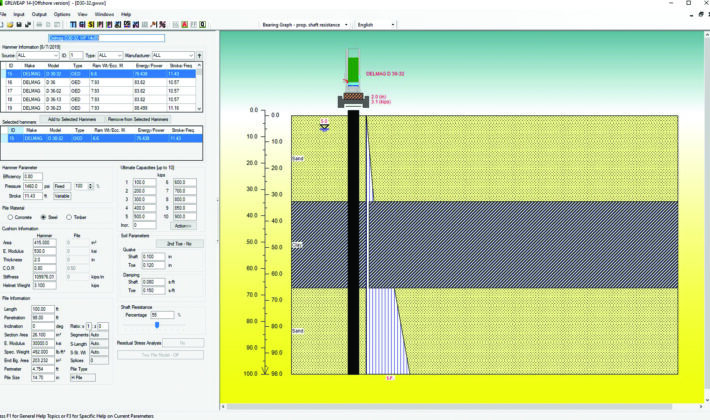
Comprehensive Hammer Database with Over 1,050 Models
- Over 1,050 preprogrammed hammer models from multiple manufacturers, including both impact and vibratory hammers
- Greatly improved hammer maintenance program allowing users to create their own hammer database files and store them at any user-defined location
- Support for opening multiple hammer database files simultaneously, with the ability to copy and duplicate hammer records between files
- Easy addition, removal, and editing of hammer data with built-in error checking to prevent obvious input mistakes
- Prevents users from inadvertently modifying the original PDI hammer data files
- Added total hammer weight field for generating default assembly weights, plus Note fields for each hammer entry and each database file
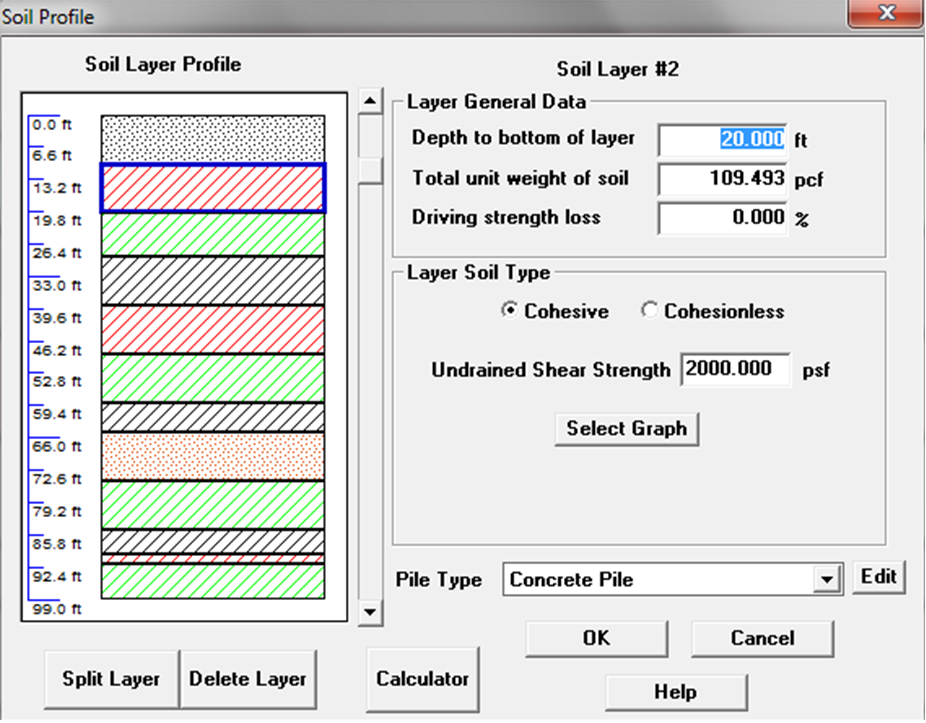
Multiple Geotechnical Static Analysis Methods
- ST (Simple Soil Type) method: analysis based on basic soil classification, suitable for preliminary survey stages
- SA method: based on SPT N-value and soil type, now extended to allow input of friction angle and unconfined compressive strength
- CPT method: based on Schmertmann (1978) theory, using Cone Penetration Test data
- FHWA/Driven method: combining Nordlund method for granular soils and Tomlinson method for cohesive soils per FHWA recommendations
- API2 method based on API 2007 specifications, including advanced CPT-based methods: Simplified ICP-05, Offshore UWA-05, Fugro-05, and NGI-05 (Offshore version)
- A&H method (Alm and Hamre, 2001): calculating friction fatigue shaft resistance distribution using CPT data, including shape factors and setup factors (Offshore version)
- Improved soil layer input and data interpolation, allowing use of large single soil layers without loss of accuracy (default computational segment length ≤ 0.5 m)
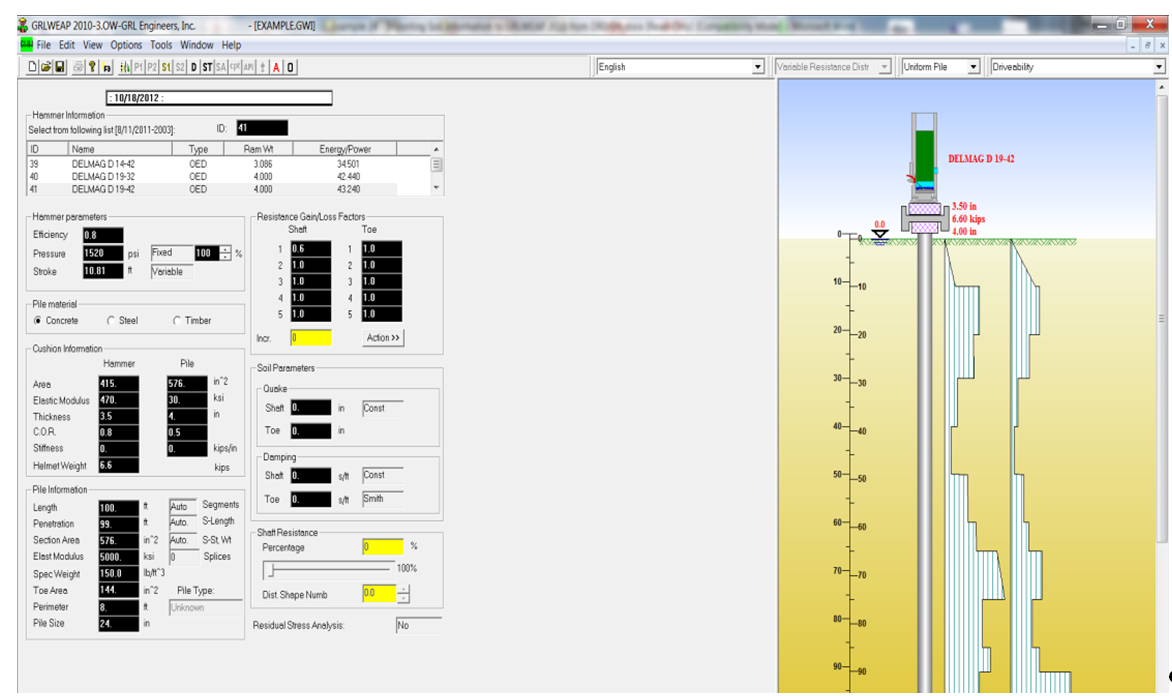
Flexible Pile Modeling with Pile Builder
- Pile Builder allows construction of non-uniform piles with different head, shaft, and toe sections within a single pile
- Support for exporting and importing user-generated pile profiles for convenient project data reuse
- Expanded database now includes sheet pile profiles and additional H-pile types
- No limit on the number of computational pile model segments (previously capped at 498), improving calculation accuracy for long piles
- No limit on soil data input lines (previously capped at 100) and the number of soil segments
- Offshore version provides Advanced Pile Builder with multiple add-on capabilities, including complex pipe piles with stabbing guides and accurate cut-off calculations
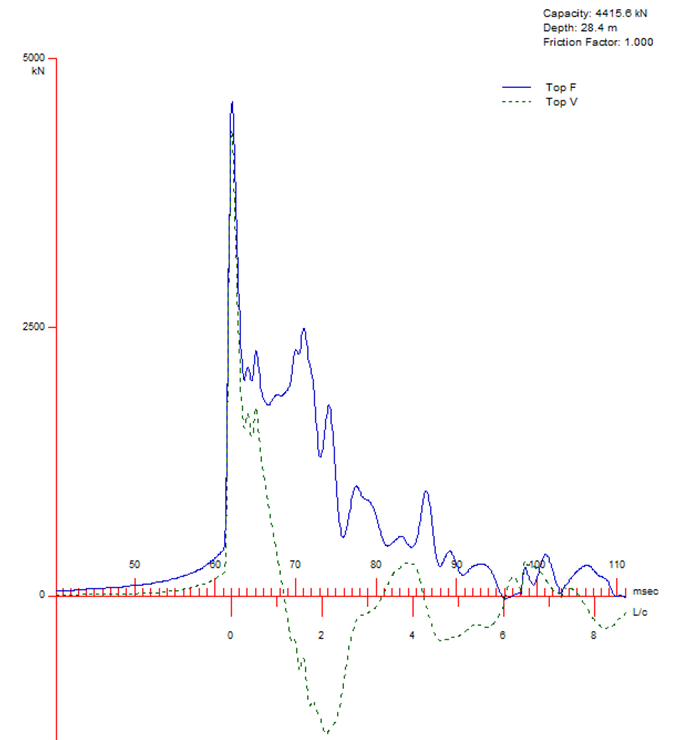
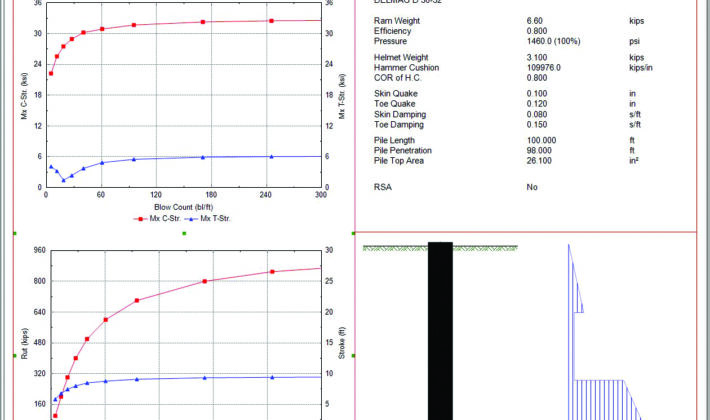
Comprehensive and Intuitive Output Graphics
- Bearing Graph: depicts the relationship of pile bearing capacities, driving stresses, stroke, and blow count, enabling capacity estimation from observed blow count or determination of required blow count for a specified capacity
- Driveability Graph: plots capacity, blow count, and dynamic stress extrema versus depth, allowing consideration of hammer energy changes, cushion deterioration, soil resistance degradation, and soil setup during driving interruptions
- Inspector's Charts: depicts stroke (or hammer energy) versus blow count for a single capacity value, used to establish a driving criterion and as an aid in construction control
- Variable vs. Time Graph: shows any calculated quantity as a function of time for comparison with field measurements or illustration of stress wave propagation
- SRD Graph: shaft resistance distribution showing both LTSR and SRD unit shaft resistance along the pile
- FF Graph: friction fatigue unit shaft resistance distributions for all analyzed depths (Offshore version)
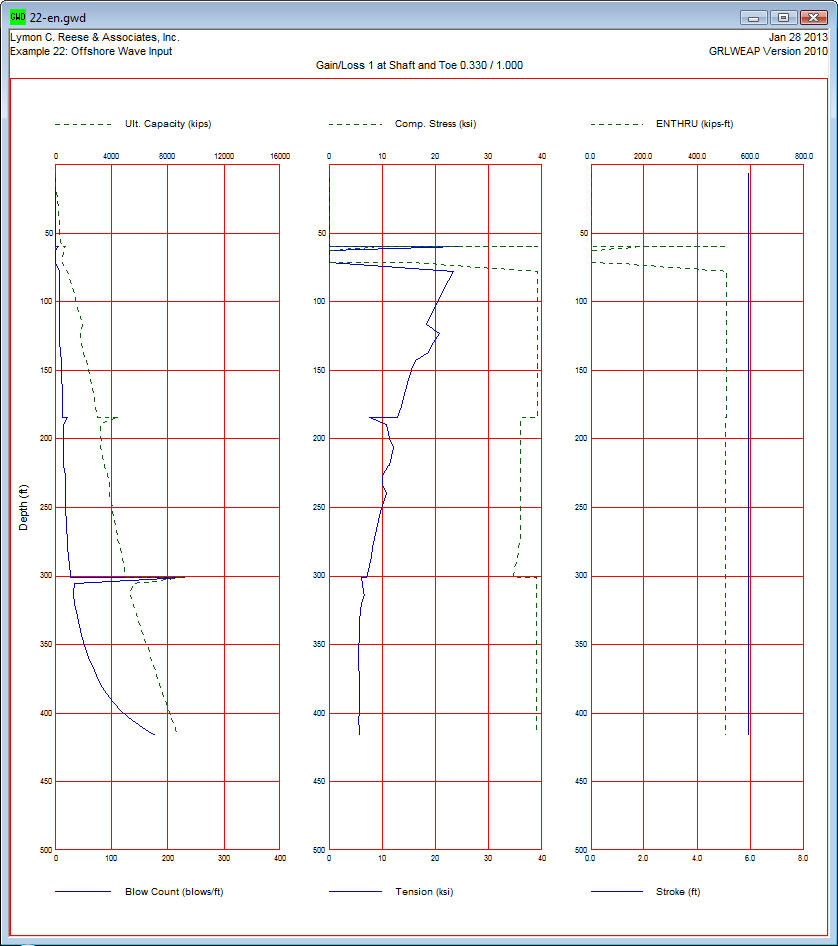
Comprehensive Driveability Analysis and Installation Time Estimation
- Determines whether a pile will be overstressed at any given depth during driving, preventing pile damage before it occurs
- Predicts whether refusal will likely occur before a desired pile penetration is reached, enabling timely adjustments to the driving plan
- Estimates total driving time based on calculated blow counts and hammer blow rate (blows per minute), supporting accurate project scheduling
- Allows input of multiple impact hammers for the same data set, simulating situations where a smaller hammer is used first and a more powerful unit takes over as driving becomes harder
- Models pile driving after interruptions (splicing, weather delays, hammer replacement), considering soil resistance degradation and soil setup
- Flexible stroke options for diesel hammers enhance the realism of the simulation
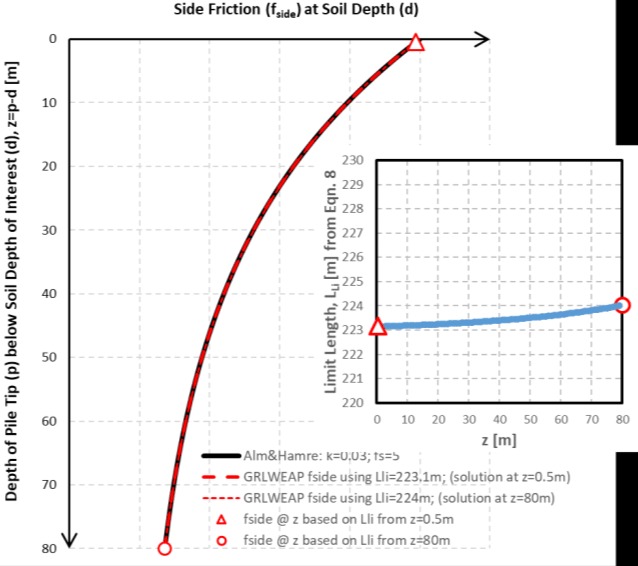
Offshore Version for Marine and Nearshore Structures
- Advanced Pipe Pile Builder: simplifies input for complex pipe pile sections including stabbing guides and multiple add-ons
- Flexible hammer location: allows placement at the pile top, bottom, or at any point along the pile length
- Static bending analysis for inclined pile driving by free-riding hammers, calculating combined static bending and dynamic compression stresses
- Fatigue damage output tables showing maximum compressive and tensile stresses multiplied by the number of occurrences for each pile segment
- Two friction fatigue shaft resistance calculation options: GRLWEAP method and A&H (Alm and Hamre) method
- Soil plug weight consideration in static equilibrium analysis, evaluating the contribution of soil weight to pile driveability
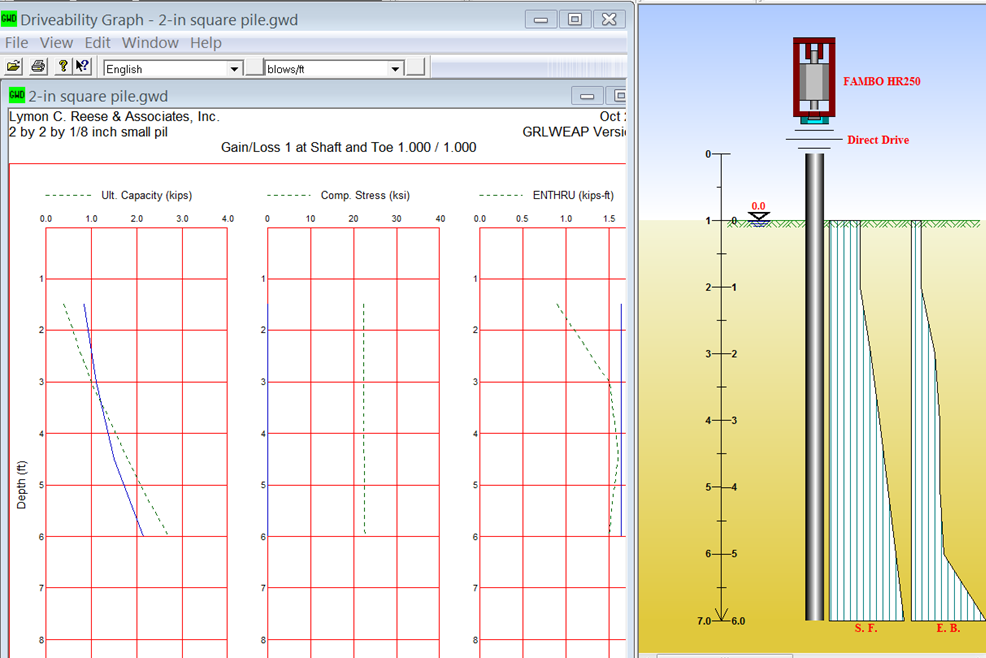
User-Friendly Interface and Optimized Workflow
- Extended and improved input wizard covering all necessary parameters for every type of analysis, minimizing data entry errors
- Quick Review feature displays analysis result summary during input generation for immediate feedback
- Double-clicking on any graphic model component on the main screen opens the corresponding input window
- Soil descriptions appear directly on the main screen graphic display when built-in geotechnical analysis tools are used
- Data sharing (copy/paste) with other applications such as Excel enabled for all output features
- Standard report styles covering most result combinations, with the ability to save reports as PDF or print directly (custom reports available in Offshore version)
Software versions
| Feature | Professional | Offshore Wave |
|---|---|---|
| Hammers in database | >1,050 | >1,050 |
| Bearing Graph analysis | ||
| Driveability analysis | ||
| Inspector's Charts | ||
| Residual Stress Analysis | ||
| Multiple Hammer Analysis (Bearing Graph) | ||
| Multiple Impact Hammer (Driveability) | ||
| Standard Pile Builder | ||
| Advanced Pile Builder (Multiple Add-ons) | ||
| API, API2, A&H methods | ||
| Friction Fatigue Analysis | ||
| Alternate Hammer Location | ||
| Static Bending Analysis | ||
| Fatigue Damage Tables | ||
| Custom Report Styles | ||
| Soil Plug Weight |
Licensing Options
Single User License
- Install on an unlimited number of computers
- Only one user may use the program at a time on one computer (not a shared license)
- Includes 2 free deactivations for license transfer to another computer
- Additional deactivation packages available at $25 for 2 more transfers
Network License
- Starting at 3 seats, allowing 3 or more concurrent users
- Install on multiple computers across the network
- Seats can be released for other users to access the license
- Usable from any office location around the globe
License Transfer and Reactivation Policy
- Free license transfers for all Single User licenses when properly deactivated on the old machine
- Reactivation fee applies when a deactivation code cannot be generated due to computer failure, reformatting, or system malfunction
Core Benefits of Using GRLWEAP 14
Practical advantages that help engineering teams and project managers make accurate decisions, optimize costs, and minimize construction risks.
Enhanced Prediction Accuracy for Pile Driving
- The accuracy of predicted driving stresses, bearing capacities, blow counts, and installation time has been continuously improved and verified by matching results with field observations from the PDA (Pile Driving Analyzer®) system
- Calculation model based on one-dimensional wave equation theory, simulating detailed stress wave propagation through the hammer, cushion, helmet, and pile system
- When wave equation analysis is used instead of traditional dynamic formulae, several codes and standards of practice allow leaner foundation designs with lower factors of safety or higher resistance factors, yielding more economical solutions while maintaining safety
- Detailed diesel hammer stroke options and soil sensitivity analysis enhance the realism of simulation results
Optimized Pile Driving Equipment Selection
- The software helps evaluate which hammer is likely to be sufficient and economical for a given pile, soil, and capacity requirement before mobilizing the hammer to the job
- Allows input of multiple hammers for the same data set in Bearing Graph and Driveability analyses, comparing the effectiveness of different hammer options
- Import hammers from different files and locations with filtering capabilities to assist in selecting the right hammers from the database
- Supports individual hammer driving system inputs for multiple hammer analysis, accurately simulating real-world construction scenarios
Risk Mitigation and Construction Safety
- Determines whether a pile will be overstressed at any penetration depth during driving, preventing pile damage before it occurs
- Predicts whether refusal will likely occur before a desired pile penetration is reached, allowing engineers to adjust the driving plan in a timely manner
- The Driveability Graph provides a comprehensive view of stress and blow count variations with depth, supporting decisions on hammer changes or driving method adjustments when needed
- Construction interruption analysis (splicing, weather delays, hammer replacement) with consideration of soil resistance degradation and soil setup, accurately simulating real-world conditions
Project Time and Cost Savings
- Estimates total driving time based on calculated blow counts and hammer blow rate (blows per minute), supporting precise project scheduling
- Enables leaner foundation design when using wave equation analysis instead of dynamic formulae, reducing safety factors or increasing resistance factors per applicable codes, thereby saving material and construction costs
- Input wizard and Quick Review feature reduce model setup time, increasing the productivity of the engineering team
- Direct data export to Excel and PDF report generation simplify the reporting and results-sharing process
International Standards Compliance
- GRLWEAP 14 version 14.2.2.0 is FIPS compliant (Federal Information Processing Standards, USA)
- Integrates API2 method based on API 2007 specifications, including highly recommended CPT-based methods: Simplified ICP-05, Offshore UWA-05, Fugro-05, and NGI-05
- FHWA/Driven method combining Nordlund and Tomlinson per FHWA (Federal Highway Administration) recommendations
- Supports both traditional US Units and SI Units, accommodating diverse international and domestic project requirements
- Includes seven geotechnical static analysis methods (ST, SA, CPT, FHWA/Driven, API, API2, A&H), addressing a wide range of engineering practice standards
Industry Applications of GRLWEAP 14
Wave equation analysis solutions suitable for diverse infrastructure, building, and marine construction projects.
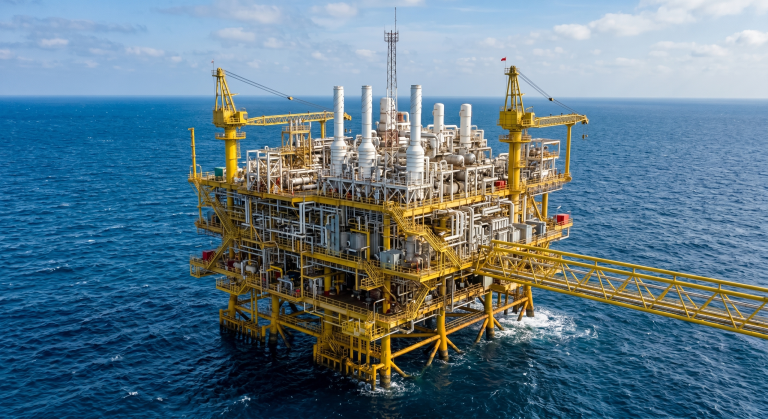
Marine and Offshore Structures
- The Offshore Wave version is specifically designed for complex situations in offshore and nearshore pile driving, including large-diameter pipe piles and free-riding hammer installations
- Advanced Pipe Pile Builder simplifies modeling of complex pipe pile sections with stabbing guides and multiple add-ons
- Pile material fatigue analysis and soil friction fatigue assessment serve durability evaluation under wave and dynamic loading conditions
- Flexible hammer placement at multiple points along the pile length accommodates unique offshore construction configurations
- Soil plug weight consideration in static equilibrium analysis, an important factor in large-diameter pipe pile design
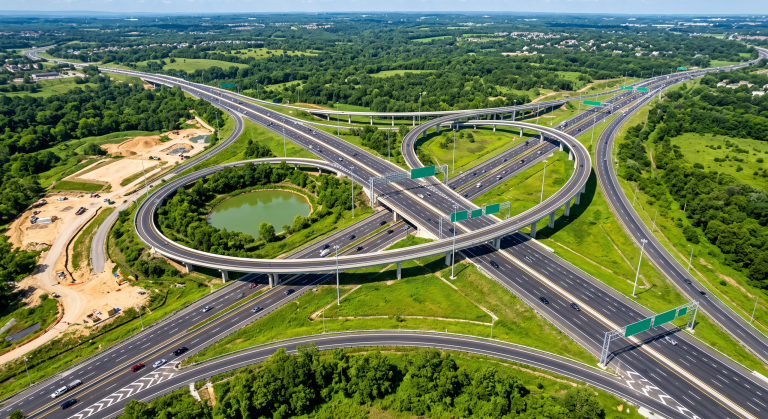
Transportation Infrastructure and Bridges
- GRLWEAP supports drivability assessment for bridge foundations, abutments, and tower piers, helping select appropriate equipment before mobilization
- Comprehensive driveability analysis predicts blow counts, stresses, and driving time for each soil layer, supporting accurate transportation project scheduling
- When wave equation analysis is used instead of dynamic formulae, many codes allow bridge foundation design with lower safety factors, reducing material costs
- The integrated FHWA/Driven method meets Federal Highway Administration standards, commonly applied in international bridge projects
- Support for battered (inclined) pile analysis, suitable for bridge foundations subjected to lateral loading

High-Rise Buildings and Industrial Structures
- The software helps design teams evaluate optimal pile and hammer configurations for high-rise building and industrial plant foundations
- Bearing Graph provides intuitive information on the relationship between bearing capacity, driving stress, and blow count, supporting foundation engineers in making accurate design decisions
- Multiple geotechnical analysis methods (ST, SA, CPT, FHWA) allow selection of the most appropriate method for site-specific soil conditions
- Inspector's Charts serve on-site construction monitoring, ensuring piles achieve the design bearing capacity upon completion
- Enables leaner foundation design with higher resistance factors per applicable codes when using wave equation analysis, saving pile material costs for large-scale projects
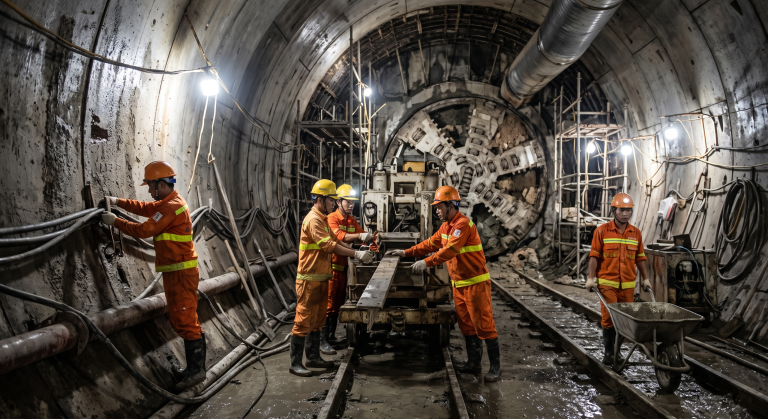
Culverts and Underground Structures
- When the pile driving angle is horizontal, GRLWEAP can be used to simulate the installation of culverts, extending the software's application scope to underground structures
- Inclined pile analysis with simplified input, accommodating various driving angles for underground construction projects
- The Offshore version provides static bending analysis for inclined pile driving by free-riding hammers, calculating combined static bending and dynamic compression stresses
- Driveability analysis helps predict installation time and feasibility for horizontal or inclined pile driving, ensuring the construction plan is viable before field mobilization
Frequently Asked Questions About GRLWEAP 14
A quick comparison between the Professional and Offshore Wave versions to help you choose the right fit.
- GRLWEAP 14 is available in two versions: Professional and Offshore Wave
- The Professional version is ideal for standard driven pile analysis, including Bearing Graph, Driveability, Inspector’s Charts, residual stress analysis, standard Pile Builder, and multiple geotechnical analysis methods (ST, SA, CPT, FHWA/Driven)
- The Offshore Wave version includes all Professional features plus specialized capabilities for marine construction: advanced Pipe Pile Builder, flexible hammer location, static bending analysis, fatigue damage tables, API2 and A&H methods, friction fatigue analysis, and custom report styles
- Both versions share the database of over 1,050 hammer models and support Single User or Network licensing
Details on the seven integrated analysis methods, from basic to advanced.
- The Professional version includes: ST (soil type based), SA (SPT N-value and soil type based, extended for friction angle and unconfined compressive strength input), CPT (Schmertmann, 1978), and FHWA/Driven (combining Nordlund and Tomlinson)
- The Offshore Wave version adds: API (based on API 1993), API2 (based on API 2007 with advanced CPT methods including Simplified ICP-05, UWA-05, Fugro-05, NGI-05), and A&H (Alm and Hamre, 2001, using CPT data)
- GRLWEAP 14 improves soil layer input, allowing the use of large single soil layers without loss of accuracy (default computational segment length ≤ 0.5 m)
- Added improved treatment of end bearing at soil layer interfaces considering soil strength values above and below the pile toe location
Information on system requirements and license types.
- GRLWEAP 14 is compatible with Windows 7, 8, 10, and 11
- The Single User license allows installation on multiple computers, but only one user on one computer at a time, including 2 free deactivation transfers
- The Network license starts at 3 seats, allowing multiple concurrent users from any location worldwide
- The software is delivered as a license download with no USB key or physical shipping required
- License purchase includes technical support. Contact TrueTech for detailed pricing and suitable license packages
Why wave equation analysis is the superior choice for pile driving design and construction.
- Traditional dynamic formulae use simple formulas based on energy conservation, providing approximate results with many simplifying assumptions
- Wave equation analysis uses a detailed mathematical model (Smith-type lumped mass model with Newmark predictor-corrector analysis) to simulate stress wave propagation along the pile, with detailed consideration of the hammer, cushion, helmet, splices, and soil characteristics
- Wave equation analysis results are significantly more accurate, verified against field measurement data from the PDA system
- When wave equation analysis is used instead of dynamic formulae, several codes and standards of practice allow leaner foundation designs with lower factors of safety or higher resistance factors, yielding more economical project solutions
Modeling the effects of driving interruptions on pile resistance and driving stresses.
- Yes. GRLWEAP allows modeling and analysis of the pile driving process after stopping for various reasons including splicing, weather delays, or hammer replacement
- The Driveability Graph considers soil resistance degradation and soil setup during driving interruptions
- The software allows input of multiple impact hammers for the same data set in Driveability analysis (Offshore version), simulating hammer replacement scenarios when soil conditions change
- The Professional version supports multiple hammer analysis for Bearing Graph and Inspector’s Charts, enabling comparison of different hammers under the same soil and pile conditions
TrueTech's team of specialists is ready to help you select and implement the right GRLWEAP solution.
Contact TrueTech today for a consultation on GRLWEAP 14 software, version selection tailored to your project requirements, and detailed pricing.

